

Trading journal
The trading journal that keeps itself
A trading journal is the memory of your trading: every position, its context, your state of mind and its result. Here is what to record, how to review it, and how Edgyx fills it in for you.
Free up to 100 trades · No card · No commitment
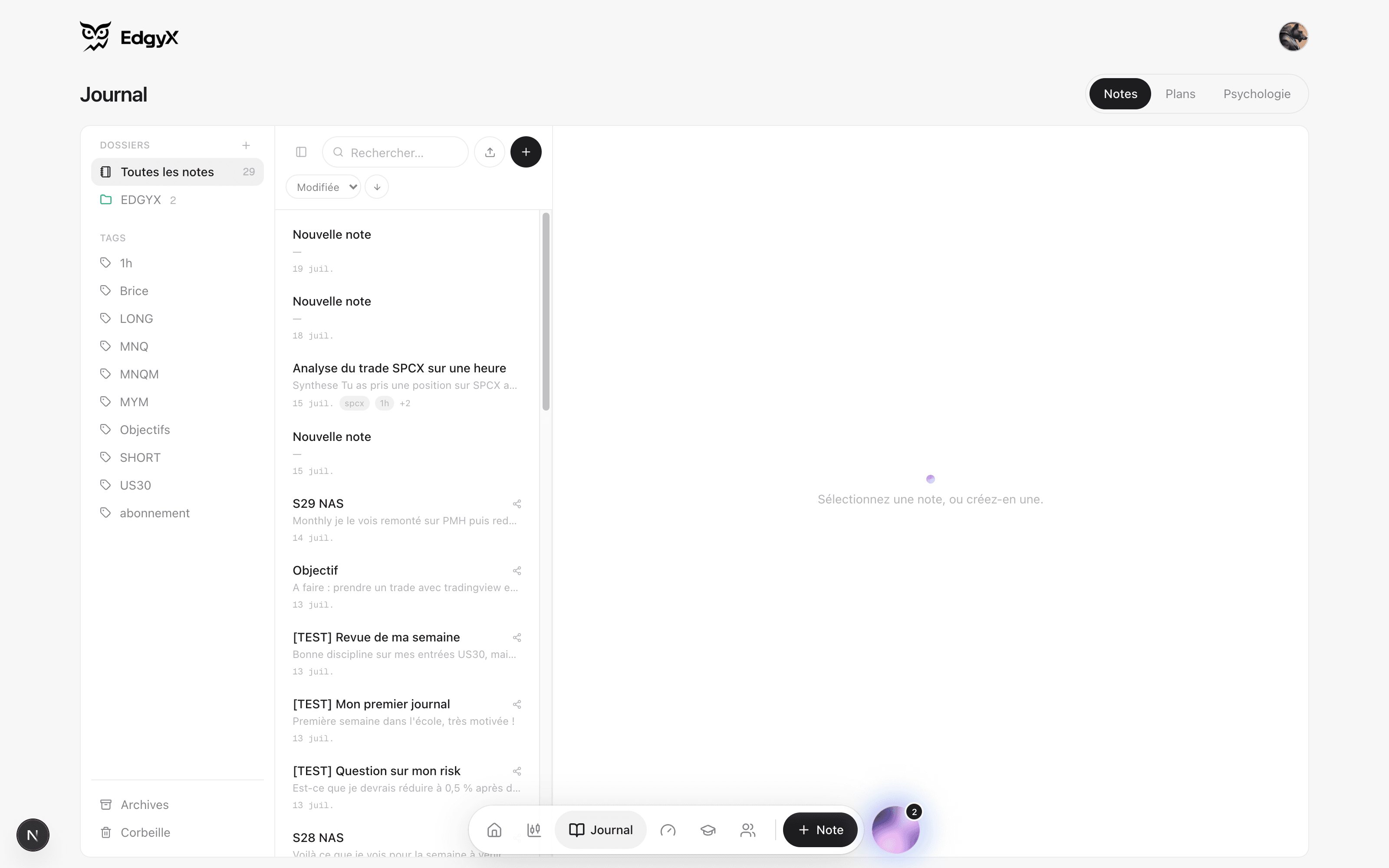
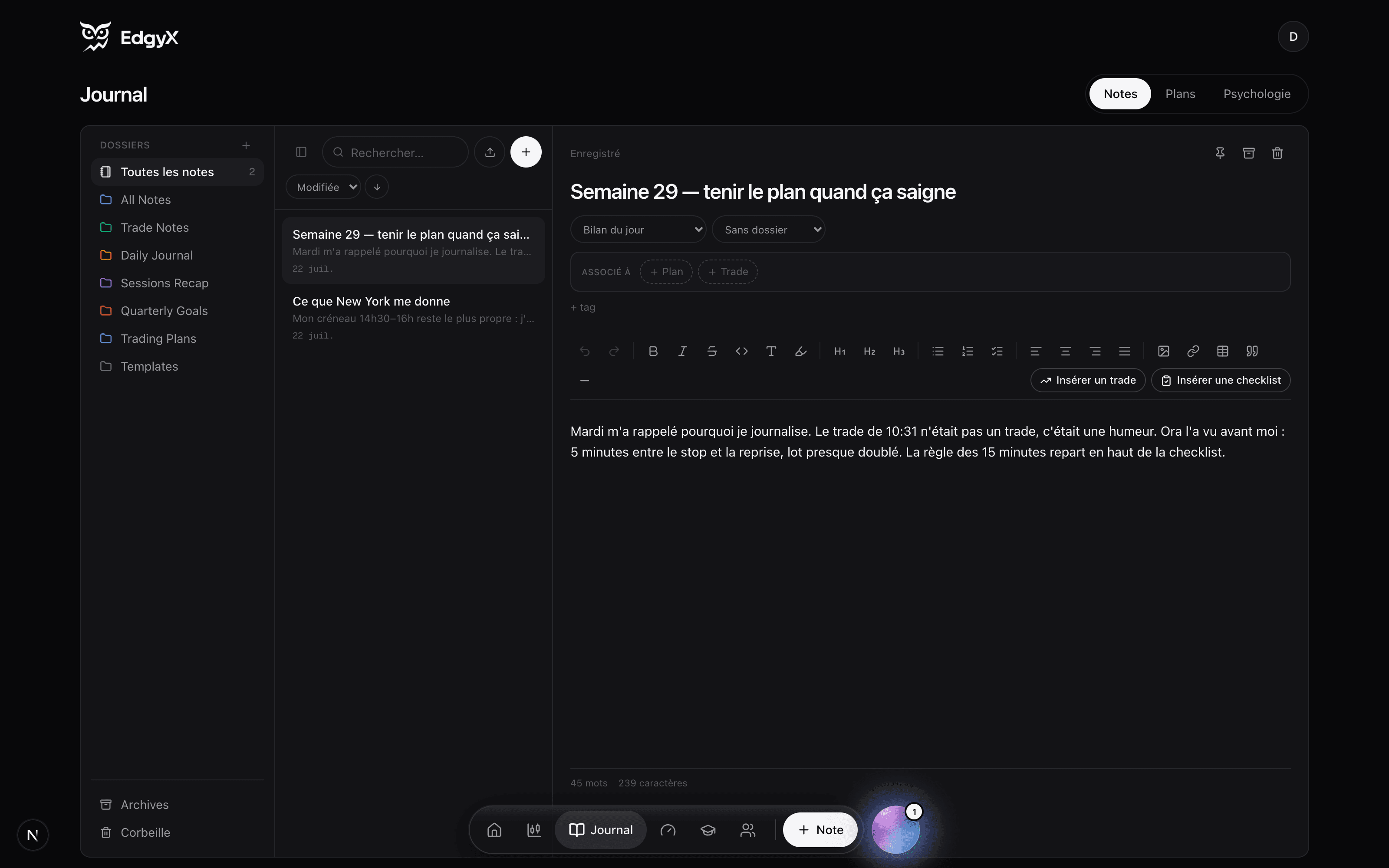
What is a trading journal?
A trading journal is a record of all your trades: the instrument, direction, size, entry, exit, stop, result, and above all why you took the position and how you felt. Reviewed regularly, it turns an impression ("I lose when I force it") into a number you can fix.
It is the simplest tool to improve, and the one most traders drop after two weeks: writing it by hand takes time, and analysing it takes even more.
What should you record in a trading journal?
The useful fields, and what each one reveals once trades add up.
| Record | What it reveals |
|---|---|
| Instrument, direction, size | Where you really make money, and whether size grows after a loss. |
| Entry, exit, stop, target | The real risk taken (in R) and whether stops are respected. |
| Date and time | The hours that pay and the ones that cost. |
| Setup or strategy | Which strategy carries your results, which one ruins them. |
| Plan followed (yes / no) | How much breaking your rules costs you. |
| Emotional state | The link between fatigue, frustration, euphoria and results. |
| Context (news, session) | How economic releases affect your trades. |
| Chart screenshot | What you saw at entry, not in hindsight. |
How to review your trading journal
Four numbers are enough to start, then a short routine every week.
- Win rate
- The share of winning trades. On its own it says nothing: a 40% win rate can be very profitable.
- Expectancy per trade
- What a trade earns on average, wins and losses included. This is the number that tells you whether you have an edge.
- Profit factor
- Total gains divided by total losses. Above 1, the strategy makes money.
- Maximum drawdown
- The largest drop in capital from a peak. It is what blows up a prop firm account.
The weekly review, in 20 minutes
- 1Reread your losing trades without judging them: was the plan followed?
- 2Isolate one recurring mistake (time of day, setup, revenge trade).
- 3Write one rule for the next week, just one.
- 4Check the following week whether the rule held, with numbers.
Notebook, spreadsheet or software: which journal to choose?
| Paper notebook | Excel / Google Sheets | Edgyx | |
|---|---|---|---|
| Trade entry | By hand | By hand or export | Automatic (MT4, MT5, cTrader, Tradovate, TradeLocker) or CSV import |
| Statistics | Calculated yourself | Formulas to build | Calculated continuously |
| Emotions and discipline | Free notes | Columns to fill | Daily score measured on your actual behaviour |
| Alerts during the session | No | No | Yes, before the trade too many |
| Economic releases | No | No | Calendar and measured market reaction |
| Price | Free | Free | Free up to 100 trades, then Premium or Elite |
A notebook or a spreadsheet is enough to start. They become hard to keep up when you trade every day, which is where most journals stop.
What Edgyx does for you
The journal fills itself
Connect your account once: trades, P&L and statistics arrive with no re-entry. Or drop a CSV export, the platform is detected.
Ora reads your trades
The AI coach measures your real habits, debriefs you every Sunday and warns you during the session when a dangerous sequence starts. It gives no signals.
Releases, measured
The economic calendar shows how much the market moves after each release, and what those releases cost you.
Prop firm accounts monitored
Drawdown, daily loss, payout readiness: the alert goes out before the firm's.
Frequently asked questions
Is there a free trading journal?
Yes. Edgyx's Free plan records up to 100 trades, with no card and no time limit. A Google Sheets spreadsheet is also a fine way to start, as long as you fill it in after every trade.
How much time does it take?
By hand, count two to three minutes per trade and twenty minutes for the weekly review. With sync, only the note on your state of mind and the review remain.
Is a spreadsheet enough?
For a few trades a week, yes. Beyond that, data entry and formulas to maintain make most traders give up, and a spreadsheet does not warn you during the session.
Is a journal useful for prop firms?
Especially: drawdown rules do not forgive a bad day. The journal shows what precedes your heaviest losses, and Edgyx monitors the account limits continuously.
Which platforms can I connect?
MetaTrader 4 and 5, cTrader, Tradovate and TradeLocker with automatic sync, plus CSV import (TradingView, prop firms…). Manual entry is still possible.
Start your journal today
Connect an account or import your trades: your first statistics are ready in a few minutes.
Free up to 100 trades · No card · No commitment