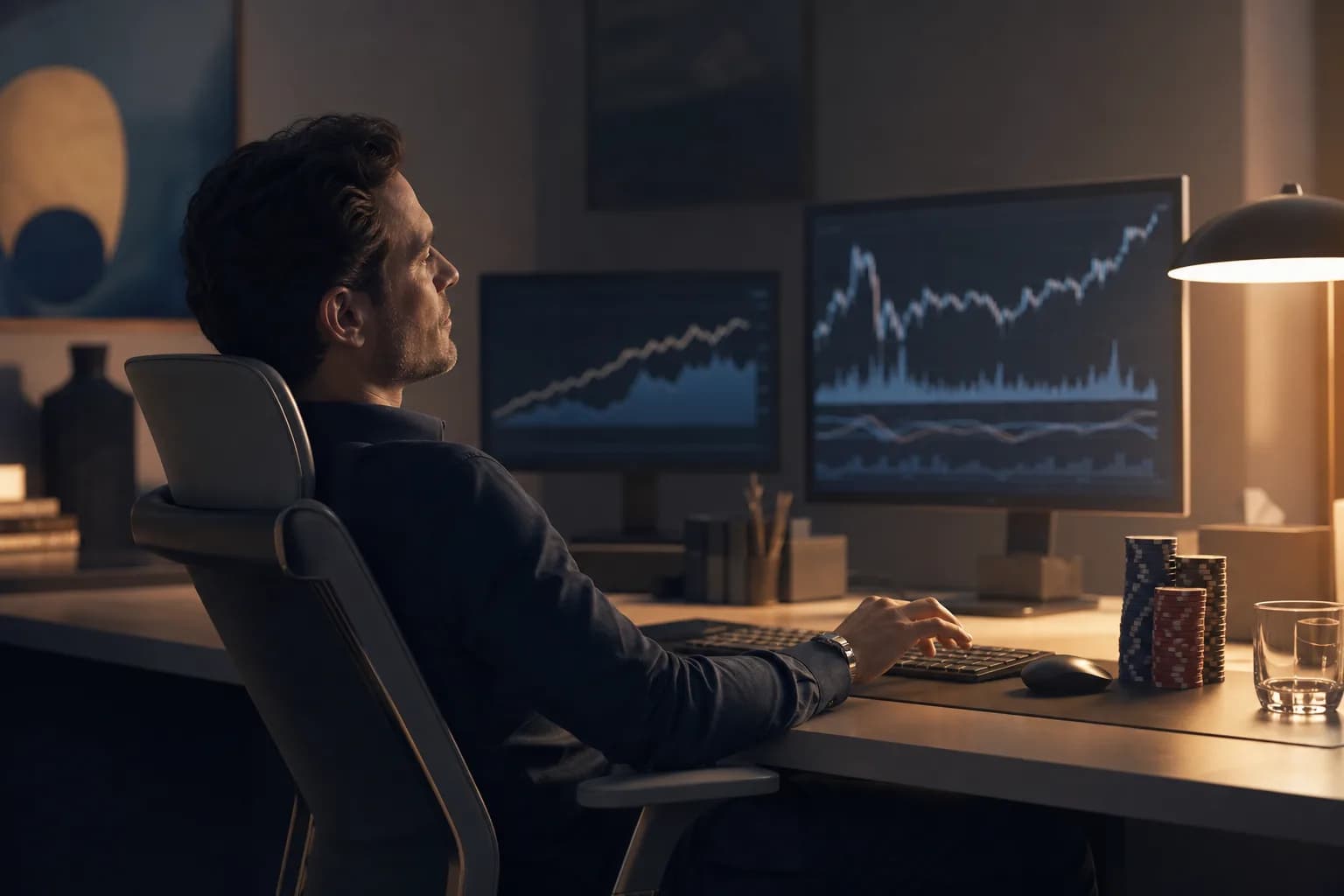


You planned to wait for a clear signal. Then you switch assets, move to a shorter time frame, and end up taking a position “just to see.” Nothing has really changed in the market; waiting has simply become uncomfortable.
When waiting feels like wasting time
Imagine a session with no open position, no loss to recover, and no spectacular move to chase. You are available, the charts are too, but your setup never appears. A thought takes hold: since you are in front of the screen, you might as well do something.
Boredom is not simply a lack of activity. In their model of boredom, psychologists Erin Westgate and Timothy Wilson link it to difficulty engaging your attention in an activity that matters to you. Looking at a screen is therefore not enough to make you feel engaged in useful work.
Their research notably distinguishes between difficulties with attention and a lack of meaning attached to the activity. A task that is not stimulating enough can be boring; so can one that is too demanding. Adding more charts is therefore not an obvious solution to the problem.
In front of your platform, ask yourself a different question: what work did you come here to do? If the implicit answer is “take trades,” every period of waiting feels like failure. Try another instruction: “monitor the conditions under which my strategy can be applied.” The absence of an order then becomes a possible outcome of the session.
Being in front of the screen creates no obligation to take a position.
What the research can tell us
The idea that boredom encourages risk-taking has scientific support. Ayşenur Kılıç, Wijnand van Tilburg, and Eric Igou observed, in their research on boredom and risk-taking, an association between boredom and riskier choices. In repeated decisions, the amount of risk taken increased with the boredom participants felt.
But the relationship is not systematic. Sergio Pirla and Daniel Navarro-Martinez conducted four experiments involving more than 1,300 participants. Their study on risk preferences found no effect of boredom on risky choices in the tasks studied. These experiments do not replicate a real trading session.
So there is no need to label yourself an impulsive trader simply because you find a session endless. Instead, look for a specific behavior in your own trades: when waiting becomes uncomfortable, do your entry criteria change? Your journal can help answer that question.

Spotting the moment when your criteria drift
Consider this scenario. You monitor an index, then open gold, a currency pair, and finally a crypto asset. None of these detours was planned. You are no longer looking for a defined setup; you are looking for a chart that will make you want to act.
Here is another possibility: the expected move never arrives. You drop to a shorter time frame. An fluctuation that did not count in your plan suddenly becomes a signal. The chart has changed scale; your method, meanwhile, has changed without an explicit decision.
Do not condemn these actions in themselves. A strategy may include several assets or time frames. The point to examine is their motive. Had you planned them, or did you add them because nothing was happening?
Pay attention to your vocabulary as well. “It should move soon,” “I’ll try something,” “just a small position”: if these phrases appear in your notes, ask yourself which concrete criterion they are replacing. A small position size does not remove the need to justify an entry.
Preparing a response to the urge to act
“I’ll be patient” remains a vague intention. The work of Peter Gollwitzer and Paschal Sheeran on implementation intentions proposes linking a recognizable situation to a precise action: if this situation occurs, then I carry out this response. These plans make it easier to turn intention into action.
Apply this principle to your waiting. Choose a rule you can genuinely follow rather than an endless rulebook.
- If I look for a new asset only because I am bored, then I return to my watchlist. Additional research can wait until I am outside the trading session.
- If I want to change time frames to find an entry, then I check whether that change is part of my method. Otherwise, I keep the planned framework.
- If I want to click without being able to name my signal, then I close the order ticket. I keep the chart, but remove the execution action from immediate reach.
- If no condition is met, then I move on to a prepared task or leave the screen. I return because of an alert or a scheduled check-in, not because I feel like looking again.
Choose your replacement task before you need it. Sort old screenshots, review an execution error, or take a break away from your phone. Avoid replacing the platform with a social feed full of trade ideas.
Plan these screen breaks when you have no position, or when your position management allows you to step away. A break should not become an improvised abandonment of monitoring.
Creating a record of your waiting
A journal filled only with executed orders leaves out sessions with no trades. Yet those are precisely the sessions that need documenting here. Otherwise, it is impossible to distinguish disciplined waiting from a session in which you missed every signal.
Add a session note, even when you did not trade. Record the setups you monitored, those that appeared, and what you did when the urge to act arose. A few factual words are enough: “no signal; opened assets outside the list; closed ticket.”
For each trade, record the time elapsed since you began monitoring or since the last decision. Add your state before the order—no boredom, some boredom, or overwhelming boredom—and specify whether the setup belonged to the plan.
In Edgyx, link these notes to your AI trading journal to keep a record of the circumstances surrounding your trades and have concrete material to discuss with Ora.
Do not classify every losing trade as “boredom” after the fact. Record your state at the time of the decision. When reviewing your journal, also check winning trades taken outside your method. The issue you are looking for is a change in behavior, not a convenient explanation for losses.
Do not turn patience into avoidance
The goal is not to collect days without orders. You could also mistake hesitation to execute a valid signal for “discipline.” Your review should therefore examine the valid opportunities you let pass, not only the trades you avoided.
After a quiet session, check what was actually available. No signal appeared and you did not improvise? Record it. A valid setup appeared while you were scrolling on your phone? Record that too. Useful waiting remains attentive to what the method calls for.
In the next session, set yourself an observable task: keep your asset list, respect your time frames, or use your alerts. Do not ask yourself to enjoy waiting. Simply organize the waiting so it does not make decisions for you.
In brief
- Boredom deserves observation, not treatment as a character flaw.
- Watch for improvised changes to your method in search of action.
- Prepare a concrete response to your main trigger.
- Record sessions without trades and valid signals that were not executed.
- Compare your behaviors before concluding that boredom explains your results.